

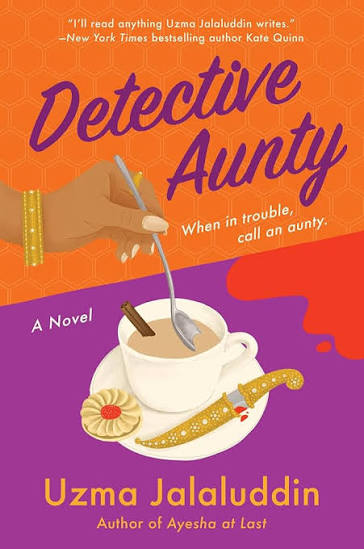
“Detective Aunty” by Uzma Jalaluddin
Published 2025 by Harper Perennial
“Detective Aunty” blends aspects of cozy mystery with traditional murder mystery. It features an older main character and unfolds with an ambling pace. Featuring Desi culture, there are references to Muslim practices and South Asian foods, clothes, and culture. The novel offers an interesting, engaging read written in perfect style.
The Main Story: Cozy or Not?
On the cozy side is an amateur detective, age 56, available, and likeable. Kauser Khan is a widow, with a past and a family in the present. The story is a murder mystery, but violence takes place off the page. There’s a “local” community, like a village., who are familiar and known to Kauser.
However, this is not set in a small village, but rather a metropolitan neighborhood of Toronto, Canada known as the Golden Crescent. The larger setting comes with a lot of characters. Social issues and some of the ugly side of life intrude. There’s very little interaction written between the main characters and the local constabulary/police. None of this tracks the cozy genre.
And then there’s the fact that the murder victim was so very unlikeable. In cozy mysteries, the murder victim is usually unlikeable, but has redeeming qualities. Or everyone feels bad for not liking the victim. There’s no pretense in this novel.
SPOILER ALERT: The resolutions aren’t cozy, either. Especially the reveal about the police.
Backstory and Subplots.
Kauser has a lot of backstory, which is dribbled out in bits and pieces. It’s nicely done, with enough early clues to allow the reader to effectively guess at some of what is coming, but still get some more details on reading to keep it interesting.
The subplots concern romantic relationships, marital issues, and friendship. For Kauser, the romance subplot is very gentle; and for this reader, it was handled perfectly and did not overwhelm the mystery focus of the novel.
For Kauser’s daughter, Sana, the subplots, both romantic and marital, are more chaotic; and for this reader, better resolution and more intensity would have been preferred.
The friendship subplots are nicely layered, with Kauser and her best friend May, and her old friend Fatima forming one complex layer, with a little extra thrown in from a minor character, Beatrice, as grandmother support.
Kauser’s teen-aged granddaughter Maleeha and her former friend Cerise (Beatrice’s granddaughter) form another layer of friendship issues. SPOILER ALERT. And then the friends at the Crescent Plaza, including Patrick Kim, Anjum the murder victim’s daughter, and Lisa (Beatrice’s daughter) form another layer that only gets sorted at the end.
There are also subplots related to possible motives for murder, including larger community corruption and land deals, local car thefts, and Crescent Plaza landlord-tenant problems.
The backstory provides texture and grounding to the family issues in Kauser’s world. The subplots complicate the story, helping to hide the mystery. They are so plentiful, perhaps too plentiful for this reader.
My Impressions.
Overall, I’m glad I read this novel. Another small nit involves ageism—56 years old is not old. The main character, at times, seemed much older than she actually is, but this could be attributed to the ageist community. I like when characters act mostly in conformity with their actual age, and don’t like younger, middle-aged characters treated as if they were old.
SPOILER ALERTS. I also think the murderer didn’t get enough show time. He’s there, but so far in the background that he’s not really someone the reader would consider a suspect.
The widow of the murdered man doesn’t get the justice due her, in my opinion.
And other problems I had revolve around unsolved issues. Who sent the threatening phone messages? We never find out. Who attacked Mr. Jin, a store-owner at the Plaza? Also unknown. And the complication with the police and how it truly impacts Sana’s situation isn’t wrapped up. Of course, these loose ends may be left open for the sequel (which I haven’t yet read). But they make the novel less satisfying.
FINAL SPOILER ALERT. Most problematic for me is the inconsistent ethics and viewpoint of the main character. When her best friend May tells Kauser that they’ll help Sana get away with murder, if she’s guilty, as if this is a no-brainer, Kauser does not express doubts or misgivings. We are led to believe this is Kauser’s moral code, in line with May’s. Family, friends first and only. And then the ending is so disruptive of this code that it feels wrong. We get an insufficient dénouement.
Conclusion:
This is so well written with culture and characters worthy of a reader’s time that a not-completely-satisfying ending is only drawback, not a deal-breaker. Recommended reading!