

If you tune in to health vlogs, you’ve heard about the six pillars of good health ad nauseum. These are the foundational stones of preventing disease, staying mentally and physically healthy, and enjoying a longer life. The six pillars (in no particular order) are to get adquate sleep, reduce stress, eat a blanaced whole-foods diet, engage in movement/exercise; have an active social connectivity, and avoid harmful substances.
Tweaking those six pillars of health, I am suggesting these six pillars of good writing health:
1. Sleep, dream, and keep a dream journal.
“People need dreams, there’s as much nourishment in ’em as food.”
With a dream journal, you can have a ready source of imaginative filler to move your novel-writing forward. You can find links between the improbable. You can converse with the dead. You can fix things. Take in the nutrients of your dreams by preserving them in a dream journal.
2. Use your stress and your stress-reduction to fuel your imagination.
“There are some things you learn best in calm, and some in storm.”
―Willa Cather
You can use your stress to invigorate your story. Characters facing challenges understand and reflect stress. Your stress on the page will feel real! Or you can use your methods of stress reduction—like taking a shower or going jogging—to let your mind relax and fill up with new ideas. The shower can be a steamy plot chamber! A good long walk outdoors can recharge batteries and upload new insights, new characters, new smells and textures.
3. Always have plenty of snacks and beverages on hand when you write!
“I always pack a travel snack bag. You don’t want to get stuck without snacks no matter where you go!”
―Busy Philipps
Whether you are going into page one, or page 201 of your novel; or whether you are traveling in the past; or the present; or the future; whether you are going in to the unknown on a first draft or traveling through your tenth revision, snacks and drinks make writing better. I’m not alone in thinking snacks and beverages are writers’ essential fuel. For some great options to get your snack list in order, check out this website.
4. Look away from the page every twenty minutes.
“People always told me that my natural ability and good eyesight were the reasons for my success as a hitter. They never talk about the practice, practice, practice.”
―Ted Williams
Of course, writing can be a long slog. We need to practice, practice, practice. Time at the computer or other device, or the typewriter if old school, or the pad of paper if very old school means a lot of time with your eyes focused closely. While you might want to stand up and stretch, get some exercise to strengthen your glutes and make sitting long hours more comfortable, you really need to also look away! Protect your eyesight.
One option I was taught was to rub my hands together to warm them up, and then close eyes, cover with warm hands and stare at the horizon (obviously no horizon with eyes closed, but what would be a horizon if your eyes were open). Do this for 30 seconds. Repeat as necessary. Or you could try this.
5. Find your writing community.
“Regardless of climate conditions or place, in a writing life, two yearnings can feel both urgent and in conflict: to possess sufficient time to oneself, and to exist in community.”
―Melanie Drane
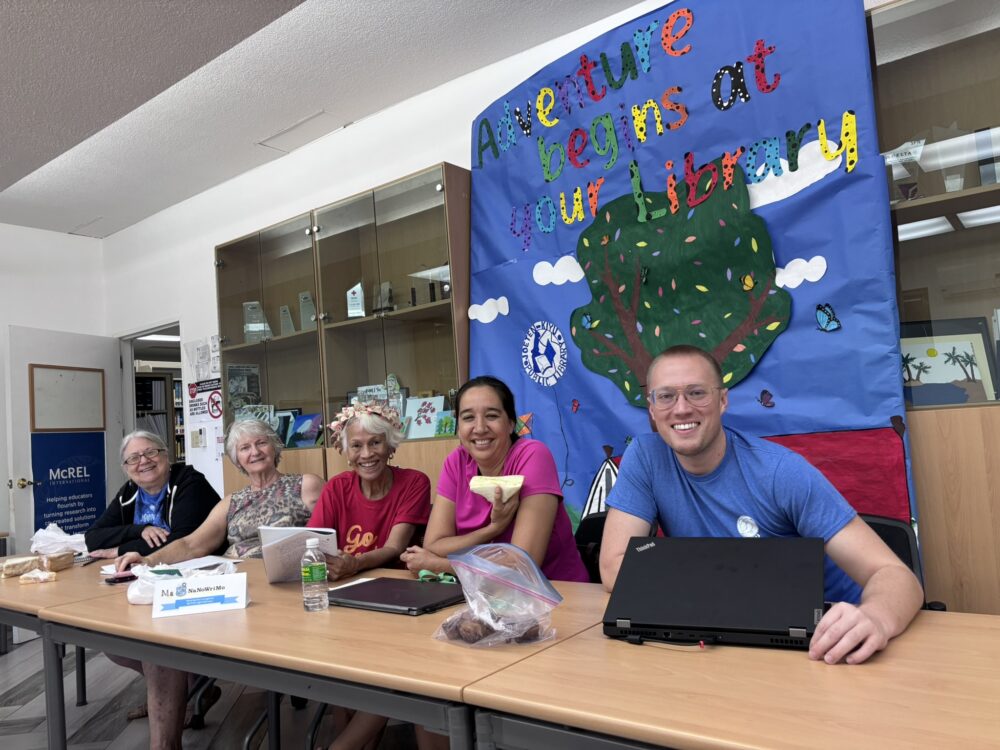
Writing is a solitary pursuit. But there are also writers’ groups. There are many kinds of groups and different ones offer different activities. I like the Marianas Writers Movement, where we have local write-ins!
Writing at a community group event is like toddler’s parallel play. It can look anti-social, because talk is usually limited. It might seem useless, because you can write alone at home without the need to transport your writing tools with you. And your productivity might be erratic, depending on what else is going on. But there are important benefits, just as for toddlers. You learn by observation—how other writers tackle their work. You develop a social awareness and identity—you are a writer! And you build confidence, because you belong to a group of writers; you are actually writing.
6. Identify and avoid your personal time-sucks.
“It is named the “Web” for good reason.”
― David Foster Wallace
Some people waste time watching television. Some spend times playing games (online, video, card games, board games, or even newspaper and book versions of crosswords, sudoku, etc.) Some of us surf the web, watch endless vlogs, listen to podcasts—bugs caught in a spider’s web. Some engage in endless activities (sports, entertainment, religion). Some people waste time worrying or procrastinating or napping. Some fall into substance abuse—alcohol, drugs, other addictions.
Whatever is your personal time vacuum-cleaner, the one that sucks up time without you even noticing it, put a label on it. Decide whether it is more important than your writing. If not, then erect as much barbed wire and alarms and barriers around it as you can.
Here’s hoping your writing life is healthy and vibrant, and these six pillars are useful to you as you continue your creative writing lifespan.