

Definition:
SNOB: a person with an exaggerated respect for social position, who looks down on those of lower rank; a person who despises people considered inferior in attainment or taste.
My impression:
When I think of snob, I think of someone who is snooty and proud of their position in society. They have some position, either from money or family or talent usually. And they look down on others, the hoi polloi, from their elevated position.
Word History
So what a surprise to learn that the word history of snob comes from the low class. In 18th and 19th century Britain, snob was a reference to shoemaker, a cobbler. Distinguished from “nob” which referred to the nobility. The term came to be associated with all of the lower class. In university communities, it referred to the townspeople (townies) and not the students. It was a broad classification of ordinary people.
In 1831, the Lincoln Herald commented on an election in Parliament, rejoicing that “the nobs have lost their dirty seats—the honest snobs have got’em.”
Evolution of meaning
But as language is wont to change, in just a few short years, nuances shoved the word from merely referring to the ordinary people to being applied to those who wanted to be more, to be refined, and in doing so were tasteless and vulgar. William Makepeace Thackery, author of the classic Vanity Fair, used the term in his 1848 Book of Snobs, in which he said it meant someone who “meanly admires mean things.” Which I suppose was a fancy way of saying an ignoble way of appreciating what doesn’t deserve so much attention. The person looking for fine distinctions in order to seem classy and elevate themselves from those who didn’t notice.
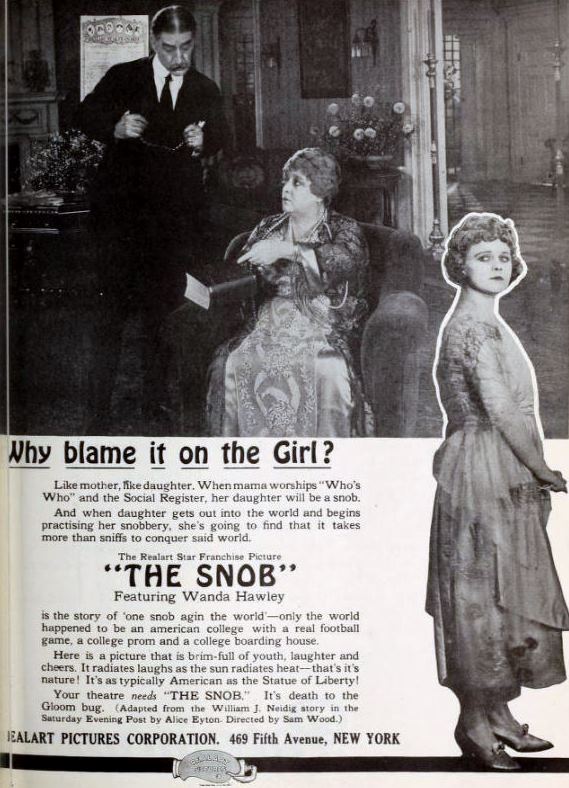
The word continued vacillating between the older meaning and the newer connotations for decades, holding its original meaning in the far flung outback of Australia well into the 1850’s but eventually the word set into its current usage. Compare the New York advertisement in 1921, our featured image.
Call to Action!
DO YOU HAVE A SNOB IN YOUR STORY? Add one now, thinking of the past and present.
Sources:
The New Shorter Oxford English Dictionary, vol. 2 (1993).
The Merriam-Webster New Book of Word Histories (1991).